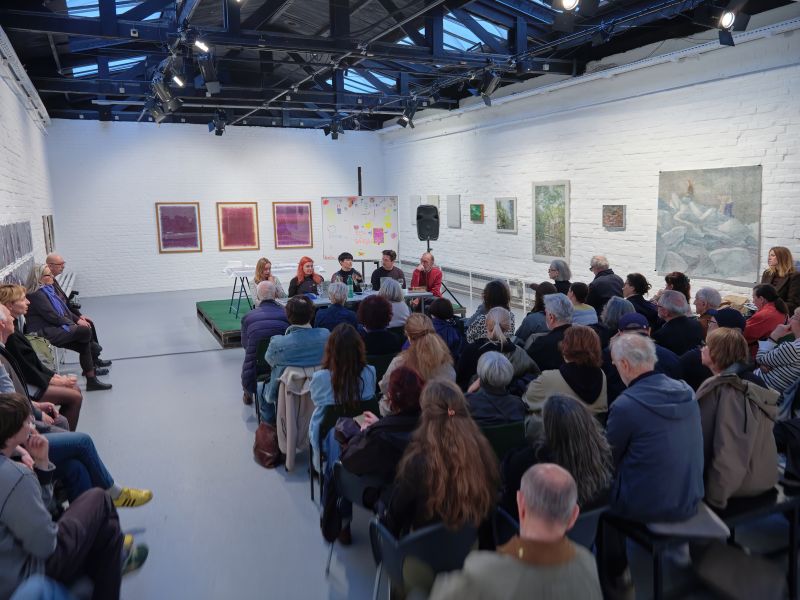
On Tuesday, 21 April 2026, at 7:00 p.m., the Gallery of the Student Centre in Zagreb hosted the presentation of Exhibition Cartographies of Želimir Koščević: Critical Instruments, Exhibition and Curatorial Narratives, a new monograph by Associate Professor Silva Kalčić, PhD. The publication was presented by Janka Vukmir, President of the Croatian Section of AICA; Suzana Marjanić, editor of the volume; Ivana Bago, contemporary art theorist; Zlatko Galić, author of the foreword written from the perspective of a former student; Želimir Koščević; and the author herself.
The Gallery of the Student Centre was not chosen as the venue by chance. It was here that Želimir Koščević, serving as director of the Gallery between 1966 and 1979, fundamentally transformed the understanding and role of curatorial practice in Croatia, aligning it with the most progressive international developments of the period. The book launch took place within the exhibition of Milivoj Bijelić, an artist who had participated in Koščević's major international exhibition Cartographers (Kartografi), organised by the Museum of Contemporary Art in Zagreb in 1997.
Silva Kalčić's book represents an attempt to historicise curatorial practice in contemporary Croatian art through the example of the long-standing work of curator Želimir Koščević. As director and curator of the Gallery of the Student Centre in Zagreb—originally constructed as the pavilion of the Kingdom of Serbs, Croats and Slovenes at the Zagreb Fair (1928–1929) according to the design of architect Ivan Zemljak, a member of the Zemlja Group—Koščević subsequently continued his curatorial career at the Gallery/Museum of Contemporary Art in Zagreb and later at the Lang Photo Gallery in Samobor.
It is important to emphasise that the history of curatorial practice remains a relatively underexplored field within Croatian art history, whereas internationally it has become an increasingly significant area of scholarly inquiry. While the history of exhibitions in the modern sense—as a manifestation of the public sphere and the universal right to public visibility—can be traced back to the revolutionary transformations of the late eighteenth century, the history of contemporary curatorial exhibitions is still being actively constituted today. This ongoing process invites critical reflection on institutional policies, exhibition formats, interpretative frameworks, and models of presentation.
Following the Rijeka Salon of 1954, which introduced the influential and authoritative figure of the curator responsible for selecting works for the salon exhibition—a development discussed by Zlatko Galić in the book's foreword—the emergence of the neo-avant-garde together with institutional critique during the 1950s and 1960s profoundly challenged established understandings of the artist, the artwork, the curator, and the audience. These developments led to a more active curatorial role in mediating new artistic practices, culminating in the authorship of thematic exhibitions, exhibition-statements, and ultimately in the radical questioning—and, at times, the dissolution—of the curatorial position itself. Such tendencies are exemplified by Koščević's exhibitions Imaginary Museum I–III (1966–1968), Exhibitions of Women and Men (1971), Mail Shipments (1972), and ultimately the major international exhibition Cartographers: Geo-Gnostic Projections for the Twenty-First Century (1997).
When curators of Koščević's generation—he was born in Zagreb in 1939—entered the cultural field, they redefined their professional role to such an extent that they assumed the position of meta-artists, a development widely recognised as the curatorial turn. Rather than relying on linear museological narratives, Koščević employed artistic methodologies within curatorial practice, treating exhibition design, museum displays, and artefacts themselves as creative material, experimenting with modes of perception, and conceiving exhibitions as integrated experiential environments.
Under Koščević's direction, the Gallery of the Student Centre became an experimental and open laboratory for deprofessionalised artistic practice. Subsequently, he extended artistic activity into the public space of the city, thereby contributing to the deinstitutionalisation of art. Alongside experimental, critical, and participatory exhibitions, he organised public discussions and debates, while actively cultivating audiences through the Gallery's educational programmes and later through those of the Gallery/Museum of Contemporary Art.
The book was co-published by the Croatian Section of AICA and Durieux (Zagreb, 2026).
Editor: Suzana Marjanić, PhD, Senior Research Associate
Peer reviewers: Professor Sonja Briski Uzelac, PhD, and Professor Krešimir Purgar, PhD
Language editor: Maja Trinajstić
Design and graphic layout: Petra Milički
Publication details
- 445 pages
- 15 × 21 cm
- Hardcover
ISBN 978-953-50937-0-1 (Croatian Section of AICA)
ISBN 978-953-188-609-3 (Durieux)
The publication was produced with the financial support of the City of Zagreb and the Ministry of Science, Education and Youth of the Republic of Croatia.
.jpg)
.jpg)
 +385 21 32 92 84
 Poljička cesta 35, Split, Croatia
 INTRANET
 WEBMAIL
 Pristupačnost