Ana Torlak, PhD, Associate Professor
Coordinator for teaching bases:
v. d. Frane Prpa, Assistant
E-mail: fprpa@ffst.hr
Website Administrator:
Art History
|
Study programme: |
University undergraduate study programme |
University graduate study programme |
|
General information on the study programme: |
The university undergraduate double-major study programme in Art History covers all fundamental content in the field of art history and enables students to develop existing professional competencies and acquire new ones. During the programme, students gain knowledge of artistic and cultural heritage from antiquity to the contemporary period, develop the ability to analyse and interpret works of art, and become familiar with methods of researching and protecting of cultural heritage. Graduates with a university bachelor’s degree in Art History have the opportunity to work in cultural institutions, museums, galleries, tourism, and in associate positions on projects related to culture and heritage, as well as in occupations requiring knowledge of art history, cultural heritage, and culture in general. The university undergraduate study programme in Art History is comparable to related programmes in the Republic of Croatia, enabling the smooth mobility of students to similar programmes at other universities in the country and abroad.
|
The university graduate double-major study programme in Art History enables students to deepen and broaden the knowledge acquired at the undergraduate level and to develop specialised competencies in the field of art history and the protection of cultural heritage. During the programme, students acquire advanced methods of research, critical analysis, and interpretation of works of art and cultural phenomena, with particular emphasis on independent research and an interdisciplinary approach.
Upon completion of the graduate study programme, students acquire competencies for work in museums, galleries, conservation departments, cultural institutions, scientific research projects, schools, tourism, and the media, as well as for positions related to the management, promotion, and interpretation of cultural heritage.
|
|
Level of study programme: |
University undergraduate study programme |
University graduate study programme |
|
Professional or academic title or degree awarded upon completion of the study programme : |
University Bachelor (Baccalaureus/Baccalaurea) of Art History
Upisnik studijskih programa Registry of study programmes |
University Master of Education in Art History (univ. mag. educ. hist. art.)
Upisnik studijskih programa Registry of study programmes |
|
Programme duration: |
3 years |
2 years |
|
Number of ECTS points acquired on completion of study programme: |
90 |
60 |
|
Application and Enrolment Requirements:
|
Detailed information about admission to the study programme is available at the following links:
|
For admission to the university graduate double-major study programme in Art History, applicants must have completed an accredited university undergraduate double-major study programme in Art History, earning at least 180 ECTS credits in combination with another double-major undergraduate study programme. The university graduate study programme in Art History may be combined with all double-major study programmes at the Faculty of Humanities and Social Sciences in Split.
|
|
Further study opportunities: |
Upon completion of the university undergraduate study programme in Art History, students may continue their studies at this Faculty by enrolling in a university graduate study programme, or in another graduate study programme at this or other faculties and universities in Croatia and abroad, subject to any differences in courses and/or credits arising from the specific features of different programmes, as stipulated by the regulations of the university and/or faculty.
|
Graduates holding the degree of Master of Education in Art History, by virtue of the competencies, knowledge, and skills acquired, are eligible to enrol in the doctoral study programme in Humanities at our Faculty, within the scientific area of the humanities, in the field of art history and other related fields.
|
|
|
Name and title |
E-mail address |
|
Department Head |
Ana Torlak, PhD, Assistant Professor |
|
|
Secretary |
Margareta Vukojević |
|
|
ECTS coordinator |
Dalibor Prančević, PhD, Associate Professor |
| prof. dr. sc. | Ivana Prijatelj Pavičić | Kabinet Odsjeka |
| izv. prof. dr. sc. | Vedran Barbarić | 224A | |
| izv. prof. dr. sc. | Ivana Čapeta Rakić | ||
| izv. prof. dr. sc. | Silva Kalčić | B222 | |
| izv. prof. dr. sc. | Dalibor Prančević | 220 | |
| izv. prof. dr. sc. | Ana Torlak | 224a |
| doc. dr. sc. | Anđelko Mihanović |
| v. pred. | Kristina Babić Džaja |
| Frane Prpa | 224A |
| v. pred. dr. sc. | Doroti Brajnov Botić | ||
| v. pred. dr. sc. | Ita Praničević-Borovac |
| dr. sc. | Jelena Jovanović | ||
| Gabrijela Nikolić | |||
| dr. sc. | Vedrana Premuž Đipalo |
| nasl. doc. dr. sc. | Darka Bilić | ||
| nasl. doc. dr. sc. | Sandi Bulimbašić | ||
| nasl. izv. prof. dr. sc. | Radoslav Bužančić |
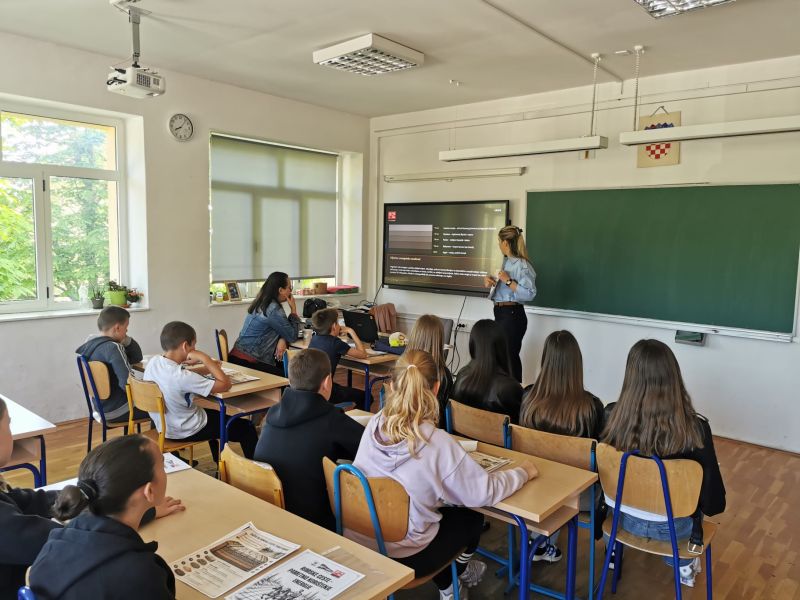
The lecture Roman Roads – An Example of Intelligent Energy Use was delivered as an interactive presentation supported by a PowerPoint slideshow, with particular emphasis on the active participation of attendees. The primary objective of the activity was to introduce children to the concept of rational and sustainable energy use through a historical case study, while encouraging critical reflection on contemporary approaches to the utilisation of energy resources.
In addition to the theoretical component, participants took part in a workshop during which they engaged in discussion, expressed their views, and related the acquired knowledge to their own everyday experiences. Particular emphasis was placed on experiential learning and practical application. Pupils completed a series of tasks using specially designed worksheets that were developed and adapted to their age group and level of prior knowledge. The worksheets included reading comprehension exercises, concept-matching activities, and problem-solving tasks focusing on energy conservation and the efficient use of energy resources. Through these activities, participants strengthened their logical reasoning, collaborative skills, and independent critical thinking.
Alongside raising awareness of the importance of responsible environmental stewardship, the activity also incorporated elements of cultural heritage education, with particular emphasis on the Roman road that has been preserved in the immediate vicinity of the school. As the children are already familiar with this archaeological site and frequently encounter its remains, the local heritage context significantly enhanced their understanding of the topic and enabled them to connect the educational content with their immediate environment.
The interactive teaching approach, together with the combination of diverse pedagogical methods, proved highly effective in fostering participants' engagement and motivation. Overall, the activity successfully contributed to raising awareness of the importance of responsible energy use, environmental sustainability, and the value of local cultural heritage while promoting active learning and critical thinking.
.jpg)
.jpg)
.jpg)